
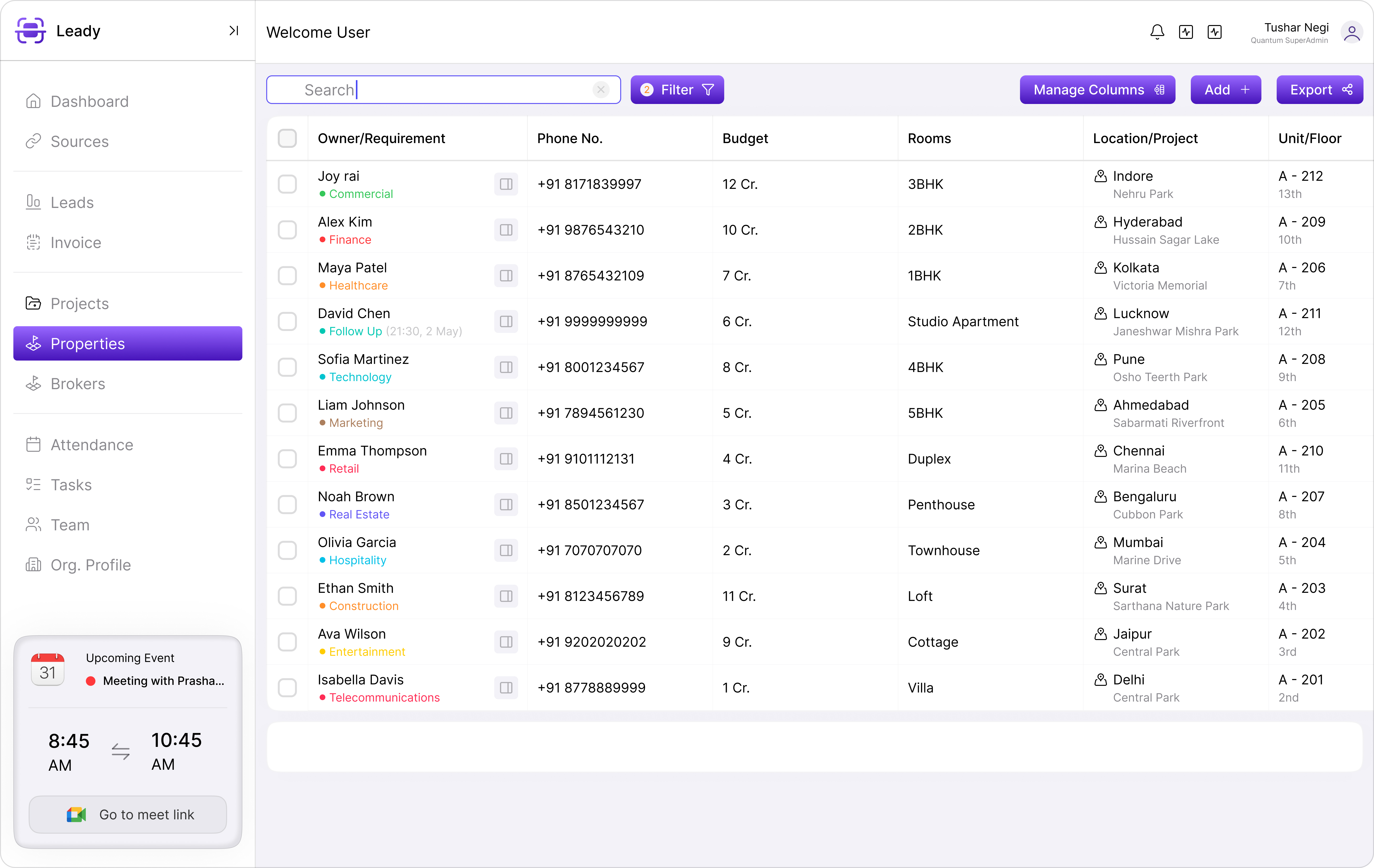
Spreadsheets worked when you launched one tower and took 40 calls a week. In 2026, with parallel projects, hundreds of broker partners, and buyers comparing five developers on WhatsApp, Excel becomes a liability. A real estate CRM is the operating system that keeps sales, inventory, and channel partners aligned.
The breaking point: when spreadsheets stop scaling
Duplicate entries, conflicting unit holds, and executives working off different versions of the same file — these are not minor inconveniences. They cost bookings. We see mid-size developers lose 8–12% of qualified leads simply because follow-up ownership is unclear or inventory data is stale.
Multi-project complexity demands centralised control
Running a plotted development in Bangalore, a high-rise in Hyderabad, and a commercial wing in NCR means three pricing structures, three broker networks, and three sales teams. Without a CRM, leadership has no single view of pipeline health. With Leady Nest, each project maintains its own inventory and team while roll-up dashboards show portfolio-wide performance.
Buyers expect instant, informed responses
- Digital-first buyers compare payment plans across developers before the first call
- NRI and HNI segments expect structured follow-up with documentation, not ad-hoc WhatsApp forwards
- Portal aggregators penalise slow response times with lower visibility on listings
- Buyers who receive a personalised reply within 10 minutes are 3× more likely to schedule a site visit
What a purpose-built real estate CRM actually does
Generic CRMs were designed for B2B software sales, not tower-wise inventory and broker commission slabs. A real estate CRM captures leads from portals, walk-ins, channel partners, and campaigns into one timeline. It ties every conversation to a specific unit preference, tracks site visits, manages holds, and surfaces the next best action for your pre-sales executive.
Inventory is not an afterthought
Unit availability, facing, floor premium, and parking allocation should live inside the same system as your pipeline. When inventory and CRM are disconnected, sales teams overpromise and operations teams firefight. Integrated inventory management eliminates that friction.
Channel partner management built in
Brokers drive 40–60% of sales for most Indian developers. A CRM without partner portals, lead registration, and commission tracking leaves money on the table. Partners who cannot see lead status stop pushing your projects — they push whoever responds faster.
“The question is not whether you can afford a CRM. It is whether you can afford another quarter of invisible pipeline leakage.”
— Sales director, Tier-1 developer in NCR
The 2026 imperative: data-driven pre-sales
RERA compliance, rising acquisition costs, and premium inventory launches all demand tighter operational control. Leadership teams need forecast accuracy, not gut feel. CRM provides stage-weighted pipeline, executive productivity metrics, and source-level ROI — the inputs for confident launch planning and channel partner negotiations.
Getting started without disrupting the sales floor
Migration does not require a six-month IT project. Start with lead capture and assignment, add inventory sync in week two, and roll out broker portals once the core team is fluent. Leady Nest customers typically reach 90%+ adoption within three weeks when workflows mirror how pre-sales already operates.
Key takeaways
- Spreadsheets fail when you run multiple projects, broker networks, and portal feeds simultaneously.
- Purpose-built real estate CRMs integrate inventory, pipeline, and channel partners — generic CRMs do not.
- Fast, informed responses are now a baseline buyer expectation, not a differentiator.
- CRM gives leadership forecast visibility and source-level ROI for smarter budget allocation.
- Phased rollout — leads first, then inventory, then partner portals — minimises disruption.