
Marketing teams report lead volume. Sales teams report bookings. Nobody connects the two — and that disconnect wastes crores in portal subscriptions, Google Ads, and broker drives that look productive but never convert. Marketing attribution closes the loop from spend to booked unit.
Why lead count is a vanity metric
A portal delivering 500 leads per month sounds impressive until you discover 4% convert to site visits and 0.8% to bookings. Another source delivering 80 leads might convert at 20%. Without attribution, marketing budgets follow volume instead of ROI — and sales teams blame 'lead quality' instead of fixing the measurement problem.
Building an attribution framework
- Tag every lead with source, campaign, medium, and creative variant at capture
- Track stage progression and booking outcome against original source tags
- Calculate cost per site visit and cost per booking — not just cost per lead
- Include channel partner referrals and walk-ins in the same attribution model
Connecting digital spend to booked units
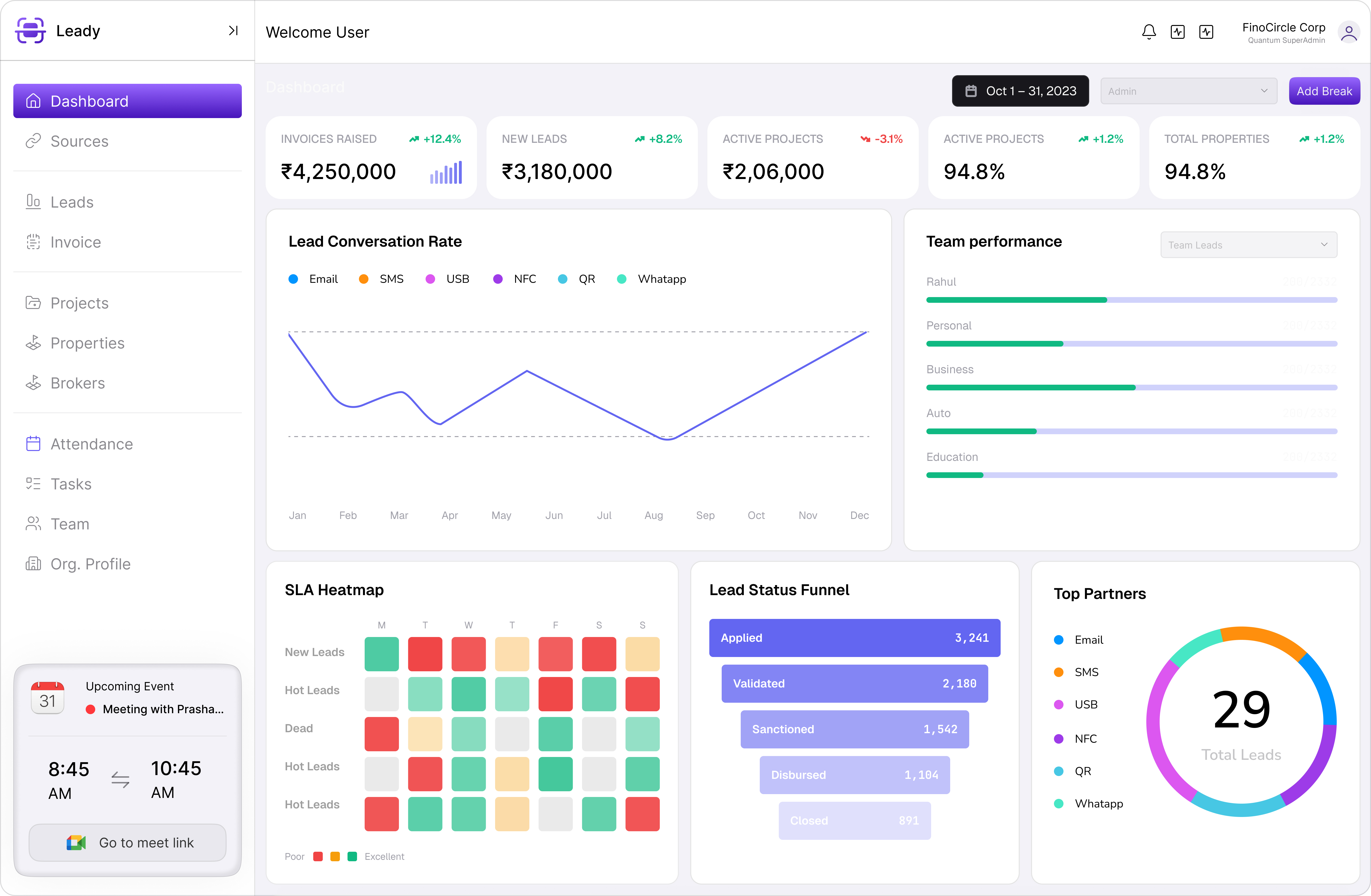
Integrate portal lead feeds, Google Ads UTM parameters, and Facebook lead forms directly into CRM. When a buyer books, the source tag travels with the record through every stage. Leady Nest's attribution reports show which campaigns produced tokens this month — not just enquiries last month.
Offline and broker attribution
Not all leads are digital. Walk-in kiosks, newspaper QR codes, and broker events need unique tracking codes or registration forms that feed CRM with source metadata. Treat broker referrals as a marketing channel with its own cost-per-booking calculation — commission is the acquisition cost.
“We reallocated 30% of our portal budget after attribution showed one platform converted at 3× the others. Same spend, more bookings.”
— Marketing head, developer in Hyderabad
Reporting cadence and action loops
Review attribution monthly with marketing and sales leadership together. Kill campaigns with high cost-per-booking. Double down on sources that produce HNI leads or fast possession buyers — depending on your inventory mix. Attribution only works when it changes decisions, not when it fills a slide deck.
Multi-touch attribution for long cycles
Indian buyers often touch multiple channels — a Google search, a portal enquiry, a broker referral, and a walk-in. Multi-touch models credit each touchpoint proportionally. Start with simple first-touch and last-touch reports, then evolve to multi-touch as your data matures.
Key takeaways
- Measure cost per booking and cost per site visit — not cost per lead.
- Tag every lead at capture with source, campaign, and creative metadata inside CRM.
- Include broker referrals and walk-ins in attribution — commission is an acquisition cost.
- Review attribution monthly with sales and marketing together to reallocate budget based on ROI.
- Evolve from first-touch to multi-touch models as buyer journey data matures.