
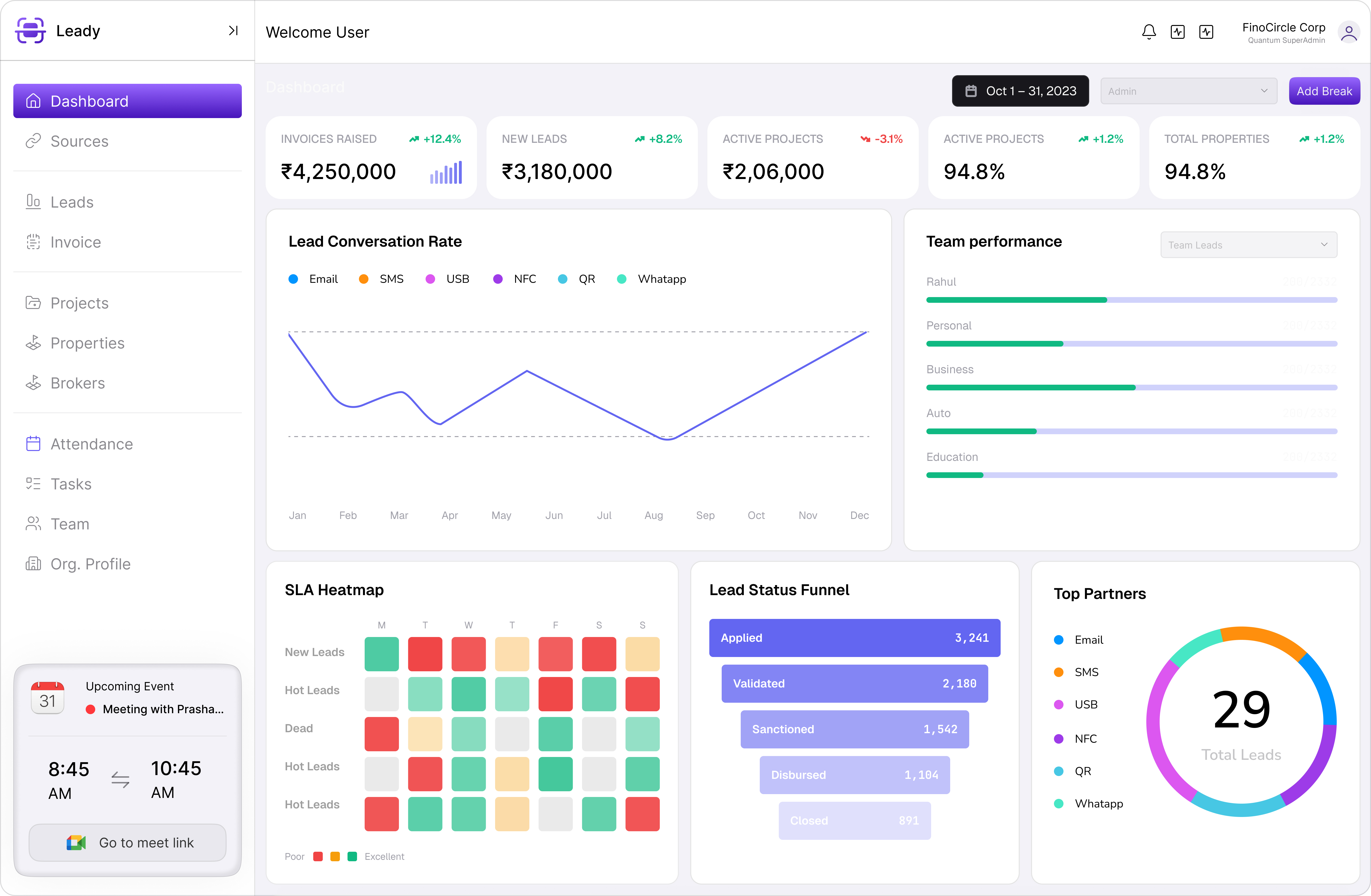
Most pre-sales teams track lead count. Top performers track stage velocity — how fast deals move from enquiry to site visit to token. Pipeline optimisation is about making bottlenecks visible before they show up as a missed quarterly target.
Design stages that mirror your actual sales process
Generic CRM stages like 'Proposal' mean nothing in real estate. Map stages to your world: Enquiry, Qualified, Site Visit Scheduled, Site Visit Completed, Negotiation, Token Received, Agreement Signed, Registration. Each stage needs clear entry and exit criteria so executives cannot advance deals without completing critical actions.
Define conversion benchmarks per stage
- Enquiry to qualified: target 40–50% with structured first-call scripts
- Qualified to site visit: target 30–40% with SLA-driven scheduling
- Site visit to negotiation: target 50–60% with same-day follow-up
- Negotiation to token: target 25–35% depending on price point and market cycle
SLA alerts that prevent deals from stalling
Set time limits per stage. If a qualified lead has no site visit scheduled within 7 days, trigger an alert. If negotiation runs beyond 14 days without a hold or token, escalate to the team lead. Leady Nest's pipeline views highlight stalled deals in red — so Monday morning reviews focus on rescue, not recap.
Identify bottlenecks with stage analytics
If 200 leads enter enquiry but only 30 reach site visit, the problem is qualification or scheduling — not closing skill. Stage drop-off charts tell you where to invest training, automation, or headcount. Without this visibility, teams blame lead quality when the process is the actual constraint.
“We discovered 60% of our deals died between site visit and follow-up. Fixing that one gap added more bookings than any new lead source.”
— Head of pre-sales, luxury developer in Mumbai
Weighted pipeline for accurate forecasting
Assign probability weights to each stage — negotiation at 40%, token received at 85%. Leadership gets a realistic booking forecast instead of inflated 'pipeline value' that never converts. Update weights quarterly based on your actual historical conversion data.
Weekly pipeline reviews that drive action
Replace status-update meetings with action-oriented reviews. For each stalled deal, assign one rescue action — revisit offer, senior escalation, broker re-engagement, or limited-time incentive. Track rescue success rate to refine your playbook over time.
Key takeaways
- Map pipeline stages to real estate milestones — not generic B2B CRM defaults.
- Set conversion benchmarks per stage to identify where deals actually stall.
- SLA alerts and stage time limits surface at-risk deals before quarter-end surprises.
- Weighted pipeline forecasting gives leadership realistic booking projections.
- Weekly reviews should assign rescue actions to stalled deals, not recap status.