
Real estate is a relationship business — but relationships alone no longer win deals. Buyers research online, compare multiple projects, and expect fast replies on WhatsApp. Agents who still rely on notebooks, Excel sheets, and scattered chats lose enquiries before they ever schedule a site visit. A purpose-built CRM turns every lead into a managed opportunity with clear next steps, history, and accountability.
The problem with managing clients without a CRM
Independent agents and brokerage teams often juggle portal leads, walk-ins, referrals, and developer inventories at the same time. Without a central system, names get forgotten, follow-ups slip, and no one knows which buyer is hottest. The cost is not only lost commissions — it is damaged trust when a buyer has to re-explain their requirements on every call.
- Leads from MagicBricks, 99acres, Housing.com, Meta ads, and WhatsApp never land in one place
- Follow-ups depend on memory instead of scheduled tasks and reminders
- Site visits, offers, and negotiations live in personal phones instead of a shared pipeline
- Managers cannot see conversion rates, response times, or which agents need coaching
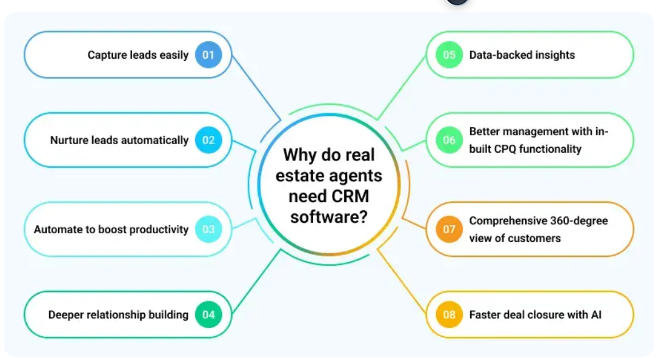
Why real estate agents need CRM software
Real estate agents need CRM software for several reasons: to capture every enquiry the moment it arrives, to follow up with discipline instead of guesswork, to coordinate site visits and inventory without chaos, and to prove performance with real data rather than end-of-month stories. In a market where buyers talk to three agents before choosing one, the agent with the fastest, most organised process usually wins.
1. Never lose a lead again
A CRM captures leads from portals, websites, ads, and manual entry into a single database. Each contact gets a timeline — source, budget, preferred location, last call notes, and next action. When an agent is offline, the lead still sits in the system ready for assignment instead of disappearing in a missed call log.
2. Faster, more consistent follow-up
Speed-to-lead is one of the strongest predictors of conversion in property sales. CRM tools automate reminders, WhatsApp templates, and task lists so warm buyers get a second and third touch without the agent having to remember. Missed follow-ups become visible, and managers can escalate stalled deals before they go cold.
3. A clear pipeline from enquiry to booking
Stages such as New Lead, Qualified, Site Visit, Negotiation, Token, and Closed help agents prioritise daily work. Instead of scrolling through an endless contact list, they open the pipeline and work the deals that are closest to closure. That structure also makes handovers clean when another team member takes over a client.
4. Better site visit and inventory management
Agents waste hours confirming availability, double-booking visits, or promising units that are already held. A real estate CRM connects buyer interest with live inventory, visit schedules, and feedback forms. After each visit, the next step — send a brochure, share a payment plan, or rebook — is logged so momentum is not lost.
“Once we moved from WhatsApp notes to a CRM, our team stopped arguing over who owned a lead and started closing the ones that were already in the system.”
— Brokerage team lead, Bengaluru
5. Professional communication buyers expect
Modern buyers expect timely WhatsApp replies, document links, and clear next steps. CRM platforms store templates for first contact, visit confirmations, and post-visit follow-up while still personalising with the buyer’s name and preferred project. That balance of speed and professionalism builds trust faster than ad-hoc messages.
6. Insights that improve your sales process
Without data, agents cannot tell which portal wastes budget, which locality converts best, or how many follow-ups a typical booking needs. CRM analytics surface conversion by source, average response time, and deal velocity. Over a few months, those insights help agents focus on high-intent channels and drop low-return busywork.
Who benefits the most from a real estate CRM?
- Independent agents managing dozens of active buyers and sellers at once
- Brokerages that need shared visibility across a sales team
- Channel partners working with multiple developer inventories
- Growing agencies that want process discipline without hiring more managers
What to look for in CRM software for real estate agents
Generic business CRMs often miss property-specific needs. Agents should look for lead capture from major portals, mobile access for field work, WhatsApp-friendly follow-up, pipeline stages that match booking workflows, and reporting that is simple enough to use every day. Platforms like Leady Nest are built for real estate teams — not adapted from generic sales software — so inventory, visits, and partner handoffs sit in the same system.
Getting started without overwhelming your team
You do not need every feature on day one. Start by importing open leads, defining pipeline stages, and enforcing a 15-minute response SLA for new enquiries. Add site visit scheduling and automated reminders in the second week. Once the team trusts the system for daily follow-up, layer analytics and channel partner workflows. Adoption succeeds when CRM replaces chaos — not when it adds extra data entry.
The bottom line
Buyers will keep comparing projects online and expecting instant replies. Agents who still run their practice on memory and chat threads will fall behind those who run it on process. CRM software is no longer a luxury for large developers only — it is the operating system for any agent who wants more closed deals with less stress.
Key takeaways
- Scattered spreadsheets and WhatsApp chats cause lost leads, slow follow-up, and zero team visibility.
- CRM centralises capture, reminders, pipeline stages, site visits, and performance data in one place.
- Faster response and disciplined multi-touch follow-up are the biggest conversion gains for agents.
- Choose a real estate CRM with portal lead capture, mobile access, WhatsApp workflows, and simple reporting.
- Start with leads, pipeline, and SLAs — then add automation and analytics once the team adopts the basics.